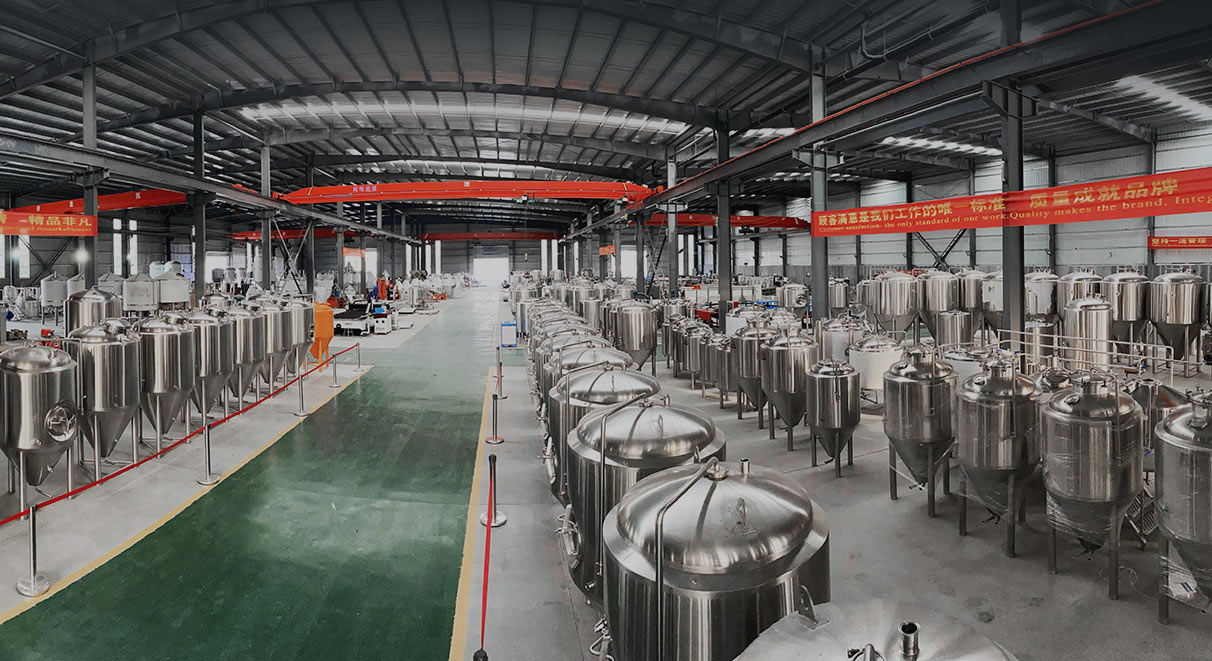
A turn-key brewery package gives a new craft brewery one coordinated system for brewing, fermentation, cooling, cleaning, utilities, controls, and packaging instead of several separately engineered purchases. In 2024, U.S. craft brewers produced 23.1 million barrels while 529 breweries closed and 430 opened, according to the Brewers Association, so equipment planning now takes place in a mature market where unused capacity is expensive. A properly sized 10, 20, or 30 BBL system should match cellar volume, brew frequency, labor, glycol demand, water supply, and packaging speed. The main advantage is fewer mismatches between production equipment and the building that supports it.
New breweries often begin by choosing brewhouse size, but annual output is usually limited by fermentation space rather than the nameplate volume of the brewhouse. One U.S. barrel equals 31 gallons, so a 10 BBL batch represents 310 gallons before normal process losses. A brewery making two 10 BBL batches per day can produce 20 BBL of wort, but that production rate only works when enough fermenter space is available for the full fermentation and conditioning period.
For example, six 20 BBL fermenters provide 120 BBL of gross cellar capacity. If the average beer occupies a vessel for 18 days, scheduling, cleaning time, yeast handling, tank headspace, and seasonal products all affect how much beer can actually move through the plant. Adding a larger brewhouse without increasing cellar volume may shorten brew days while leaving monthly packaged output almost unchanged.
That relationship is why turn-key engineering normally starts with annual production, batch frequency, beer styles, tank residence time, sales format, and expected operating days. A brewery targeting 2,500 BBL per year has very different cellar requirements from one targeting 10,000 BBL, even when both use a 10 BBL brewhouse. The supplier can then size the brewhouse, fermentation vessels, bright tanks, cooling plant, CIP equipment, and packaging area around the same production schedule.
Equipment capacity should be compared by finished-beer flow, not by brewhouse volume alone. A 20 BBL brewhouse operating below its planned number of weekly turns can cost more while producing no more packaged beer than a smaller system with better cellar utilization.
Building layout becomes the next issue because brewery vessels cannot be treated as standalone machines. Tank diameter, overall height, doorway width, floor loading, trench drains, ventilation, service access, keg movement, raw-material storage, and future tank positions all affect equipment selection. In 2024, the Brewers Association counted 3,936 taproom breweries and 3,552 brewpubs in the U.S.; many such businesses place production, hospitality, storage, and cleaning functions inside one property.
A fermenter that fits under the finished ceiling may still be impossible to stand upright if the installation contractor lacks enough lifting clearance. Piping placed too close to a future tank position can also make later expansion expensive. A coordinated supplier can place vessels on the layout before fabrication, mark connection elevations, reserve service corridors, and plan glycol, water, steam, electrical, compressed-air, and CO₂ routes before installers arrive.
Utilities deserve the same level of sizing. Brewers Association energy guidance reports typical brewery electrical use around 12–22 kWh per barrel and thermal use around 1.3–1.5 therms per barrel, with smaller breweries often using more energy per barrel because fixed equipment loads are spread over less production. Those figures make chiller, boiler, heating, and electrical-panel selection part of production engineering rather than a separate facilities purchase.
| System area | Engineering question | Typical planning issue |
|---|---|---|
| Brewhouse | How many BBL per turn and turns per day? | Vessel size without enough cellar space |
| Fermentation | How many days does beer remain in tank? | Too few tanks for the planned brew schedule |
| Glycol | What equipment cools at the same time? | Chiller selected from tank count alone |
| Hot water | How much water is needed between brews? | Recovery slower than production schedule |
| CIP | Which vessels and lines require circulation? | Pump flow or return path poorly matched |
| Packaging | How many cans, bottles, or kegs per hour? | Packaging becomes slower than cellar output |
Water use is another area where integrated design can change operating performance. Brewers Association benchmarking for breweries producing 10,000–100,000 BBL per year recorded a median water-use ratio of 5.3 barrels of water per barrel of beer from a sample of 26 breweries; the top quarter operated between 3.3 and 4.0 BBL of water per BBL of beer, while the lower quarter ranged from 6.9 to 9.9.
A brewery producing 10,000 BBL annually at a 5.3:1 ratio would therefore use about 53,000 BBL of water before accounting for how local metering boundaries are defined. Tank rinsing, floor cleaning, CIP cycles, wort cooling, packaging, and hospitality operations all contribute. Layout and piping choices influence how much water is spent moving product, rinsing lines, and recovering equipment between batches.
Cleaning design also affects beer quality and labor. Fermenters, bright tanks, heat exchangers, hoses, hard piping, pumps, valves, and fillers need repeatable cleaning procedures, while poor piping geometry can leave sections with weak circulation. A turn-key project can match CIP pump flow, spray devices, tank connections, return paths, chemical tanks, and drainage to the vessels being supplied instead of asking operators to correct the system after commissioning.
The same coordinated approach applies to refrigeration. Fermentation produces heat, cold rooms require continuous cooling, and wort or beer may create short periods of higher demand. A glycol system should therefore be selected from expected simultaneous demand, supply temperature, return temperature, piping distance, ambient conditions, and planned vessel additions rather than from a simple rule such as one chiller size for a fixed number of tanks.
Brewers Association benchmarking also shows why utility design should use measured ranges rather than assumptions. Among 28 breweries in the 10,000–100,000 BBL annual category, median electricity consumption was 22.4 kWh per barrel; the top 25% ranged from 6.7 to 18 kWh per barrel, while the lower 25% ranged from 31 to 74. Equipment selection cannot explain every difference, but motors, refrigeration, heating, operating hours, packaging, and plant utilization all contribute.
For a first brewery, commissioning matters almost as much as fabrication. Pumps need rotation checks, temperature sensors need verification, valves need functional testing, heating equipment needs operating tests, glycol circuits need balancing, and control sequences need to be checked with water before saleable wort enters the system. A supplier handling several systems together can test interfaces rather than checking each machine only as an independent item.
Factory acceptance does not reproduce the brewery building. Water pressure, electrical supply, gas service, steam pressure, drain capacity, ambient temperature, and installed pipe length can all differ from factory conditions, so site commissioning remains necessary even when equipment was tested before shipment.
Regulatory planning belongs in the project schedule as well. In the United States, a business intending to operate a brewery or brewpub must qualify for a Brewer’s Notice through the Alcohol and Tobacco Tax and Trade Bureau. TTB’s brewery guidance was updated in 2025 and separates commercial brewery operations from pilot brewing plants used for research or development. Equipment delivery alone does not authorize commercial alcohol production.
Safety requirements also affect plant design. OSHA notes that carbon dioxide is produced during fermentation and may accumulate, while grain handling and enclosed process areas can introduce additional gas and atmospheric hazards. CO₂ distribution, ventilation, gas detection, confined-space procedures, chemical storage, floor conditions, hot surfaces, and pressure-rated equipment therefore need consideration alongside production capacity rather than after employees begin operating the brewery.
Packaging deserves early attention because the sales format affects the rest of the brewery. Brewers Association data for 2024 showed that singles, 4-packs, 6-packs, and 12-packs represented 96% of scanned craft volume in the measured channels, with 6-packs alone accounting for 46%. A brewery planning packaged distribution needs filler speed, buffer capacity, cold storage, finished-goods movement, and staffing that match expected cellar output.
A taproom-focused brewery can make different choices. It may allocate more volume to serving tanks or kegs, use a smaller packaging line, and spend more floor area on cold storage or hospitality. A production brewery may need higher packaging throughput and more pallet movement. A Brewery/Distillery/Winery All-In-One Solution is most useful when the supplier develops equipment, utilities, layout, controls, and downstream handling from one operating plan instead of supplying the same package to every site.
Expansion should also be planned selectively rather than by purchasing oversized equipment everywhere. Spare glycol-header connections, electrical-panel capacity, clear tank positions, additional control I/O, and suitable pipe sizes can make future cellar additions easier. By contrast, buying several unused fermenters in year one ties cash to stainless steel before sales require the capacity.
The market data supports a more measured approach. U.S. craft production fell 3.9% in 2024 to 23.1 million barrels, while craft volume share was 13.3%; 529 craft breweries closed during the year compared with 430 openings. Retail craft value still reached about $28.8 billion and represented 24.7% of U.S. beer retail dollar sales, so new breweries enter a large market but cannot assume rapid volume growth.
Supplier evaluation should therefore go beyond the quoted number of tanks. Buyers can compare stainless grades, internal finish, welding records, jacket design, insulation, valve and pump specifications, instrumentation, electrical standards, drawings, spare parts, commissioning scope, operator training, warranty terms, and service response. They should also ask whether the quotation includes interconnecting piping, glycol distribution, control panels, platforms, CIP equipment, freight preparation, installation supervision, and startup assistance.
A useful quotation should state battery limits: where the supplier’s responsibility starts and stops. If the equipment supplier provides the glycol chiller but not field piping, for example, the drawings should still state required flow, pipe size, supply temperature, connection type, and pump conditions. The same principle applies to steam, hot water, compressed air, CO₂, electrical feeds, drains, and product piping.
In 2025 Brewers Association statistics showed 9,578 operating U.S. craft breweries, down 2.9% from 2024, reinforcing the need to size new plants around realistic production plans rather than maximum theoretical output. A turn-key package earns its place when brewhouse capacity, cellar occupancy, water, energy, cooling, cleaning, packaging, building services, compliance, and future additions have been calculated as parts of the same facility.