Mating Connectors From Different Batches
A connector pair that was mated on the bench and passed a continuity check can still be two different batches, two different platings and two different crimping tools. KUKA CABLE publishes nine laboratory test pages and a ten-item test list for PV cable, and the published answer to a mixed-batch joint is not a promise but a paper trail: 100% inspection of finished products, plus sample retention and traceability.
Key takeaways
- Mixed batches fail on tolerance and plating, not on appearance, so the record matters more than the look of the joint.
- The manufacturer lists MC4 and solar connectors, solar fuse connectors, solar diode connectors and PV cable assemblies in the same family.
- Published quality steps include 100% inspection of finished products, digital control during manufacturing, and sample retention with traceability.
- Nine laboratory test pages are published, against a ten-item test list for PV cable.
What actually differs between two batches
Three things move when a connector comes from a different production run. The first is the moulding tolerance on the housing, which decides how much force it takes to seat the latch. The second is the contact surface, where a change in plating thickness or in the base metal changes resistance across the joint and behaviour under heat cycling. The third is the tooling, because a crimp made with a different die set produces a different compression even on the same contact.
None of those differences is visible in a photograph. A joint assembled from two batches can pass a pull test on the day and still warm up over a summer, which is why the fix is procedural: keep the batch identity of both halves, and treat a mixed pair as a documented decision rather than an accident.
What the manufacturer publishes about its connector range
The solar cable topic section places connectors in the same family as the cable itself. The published items are MC4 and solar connectors, solar fuse connectors, solar diode connectors and PV cable assemblies, and the connector page carries a CE and RoHS certificate download. A solar cable connector bought from the same source as the cable is one less unknown in a joint, because the plating and the housing come from a single supplier's specification. The same page family also covers solar branch cable and PV cable assembly work.
What the site does not publish is a contact-resistance figure, an insertion-force figure or a mating-cycle count for any of those connectors. That gap is worth naming rather than filling: the datasheet for the connector model is the place to look, and if a supplier cannot produce one, the buyer is choosing on a photograph.
Where the batch record is actually built
Traceability starts in production, not in the warehouse. The company's published quality model covers raw-material selection against multiple international benchmarks, monitoring by digital control systems during manufacturing, 100% inspection of finished products for electrical, mechanical and environmental performance, and sample retention with traceability. Sample retention is the part that answers a batch question two years later: a retained piece can be re-measured when a field complaint arrives.
The laboratory behind those checks was established in December 2015 and is described as an ISO/IEC 17025 laboratory. Its published test list includes water resistance, UV accelerated weathering, abrasion, cold bending, cold elongation, tensile testing after ageing, solderability, static flexibility, and construction and dimensional testing.
The nine published test pages against the ten-item list
The manufacturer organises its evidence in two places. The test pages describe individual benches and procedures. The PV cable test list is published as a ten-item ranking of the checks that matter for a solar cable: conductor resistance, insulation resistance, dielectric strength, tensile strength, heat resistance, flame retardant behaviour, environmental adaptability, corrosion resistance and cable connectivity — nine names carried under a list titled as ten. The two counts do not match, and they are not meant to: one is a set of procedures, the other is a priority order.
| Published item | What the site says | What to check on delivery |
|---|---|---|
| MC4 and solar connectors | Part of the connector family; CE and RoHS certificate download on the connector page | Certificate copy and the model number on the bag |
| Solar fuse connectors | Listed in the same family | Fuse rating marked on the part |
| Solar diode connectors | Listed in the same family | Orientation and polarity marking |
| PV cable assemblies | Listed with solar branch cable | Assembly drawing and crimp record |
| Finished-product inspection | 100% inspection for electrical, mechanical and environmental performance | Inspection record with the batch number |
| Traceability | Sample retention and traceability as part of the quality model | Statement of how long samples are kept |
Worked example: counting the checks you can actually trace
Suppose a site uses one connector model and buys it twice in a season. If each delivery carries a batch number and each crimp is recorded against that number, the joint has two traceable identifiers. Multiply that by the number of strings on the roof: a 200-string installation with two connectors per string end carries 400 joints, and a missing batch reference leaves that many joints unattributable (my own multiplication).
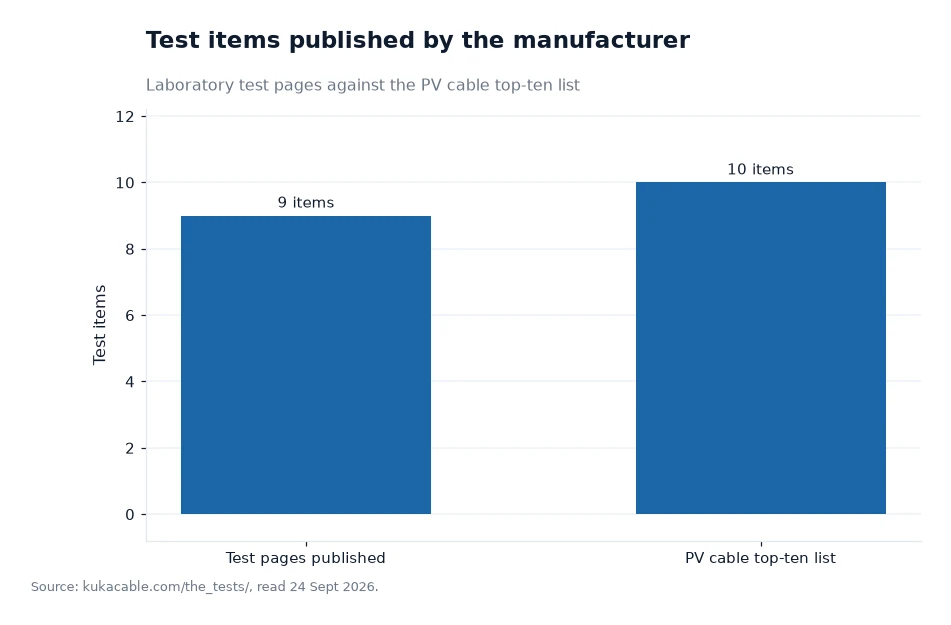
A second figure comes from the published test counts. Nine test pages are published against a ten-item list, so the list is broader than the pages (my own comparison of the two counts). When a supplier answers a batch question, ask which of those published checks the answer rests on; an answer that cites no test is an opinion.
The chart: breadth of published testing
The chart below is simply a count, drawn from the manufacturer's own pages. One bar shows nine test pages published by the laboratory; the other shows ten items on the PV cable test list. It is included here because a batch question is really a testing question: the more checks a maker publishes, the more of them a buyer can point to when two batches are mated.
Frequently asked questions
Can two batches of the same connector model be mated safely?
They can be mated, but the manufacturer publishes no cross-batch compatibility statement, so the decision is the buyer's. Record the batch identity of both halves and keep the crimp record with the string number.
Does the connector page publish an electrical rating?
The connector page carries a CE and RoHS certificate download, and the cable it mates with is rated DC 1.8/1.8 kV on the published data. A rating for an individual connector model is not published on the site and should be requested from the supplier.
What to put in the purchase order
Add three lines to the order: the connector model, the certificate to be supplied with the shipment, and a single batch number for the whole quantity. Then ask for the inspection record that the manufacturer already states it produces for finished products. If the order has to be split across two batches, note it on the delivery paperwork so the site team knows which strings carry a mixed pair. Keep the cable side of the joint to the published build while you are at it — tinned copper, class 5 to IEC 60228, 78 g/m at 6 mm² — and ask for the test list and the certificate set rather than accepting a verbal description. KUKA CABLE describes TUV certification as the starting point for its cable work, and a mixed-batch joint is exactly the kind of detail that a starting point does not cover.
No figure here is third-party: the test counts and connector data are the manufacturer's own website content, excerpted 24 Sept 2026[1].